Search

MESSAGE FROM THE CSCO


Supporting a Brand That Continues to Be Chosen Through Structural Transformation of the Supply Chain Centered on Co-creation


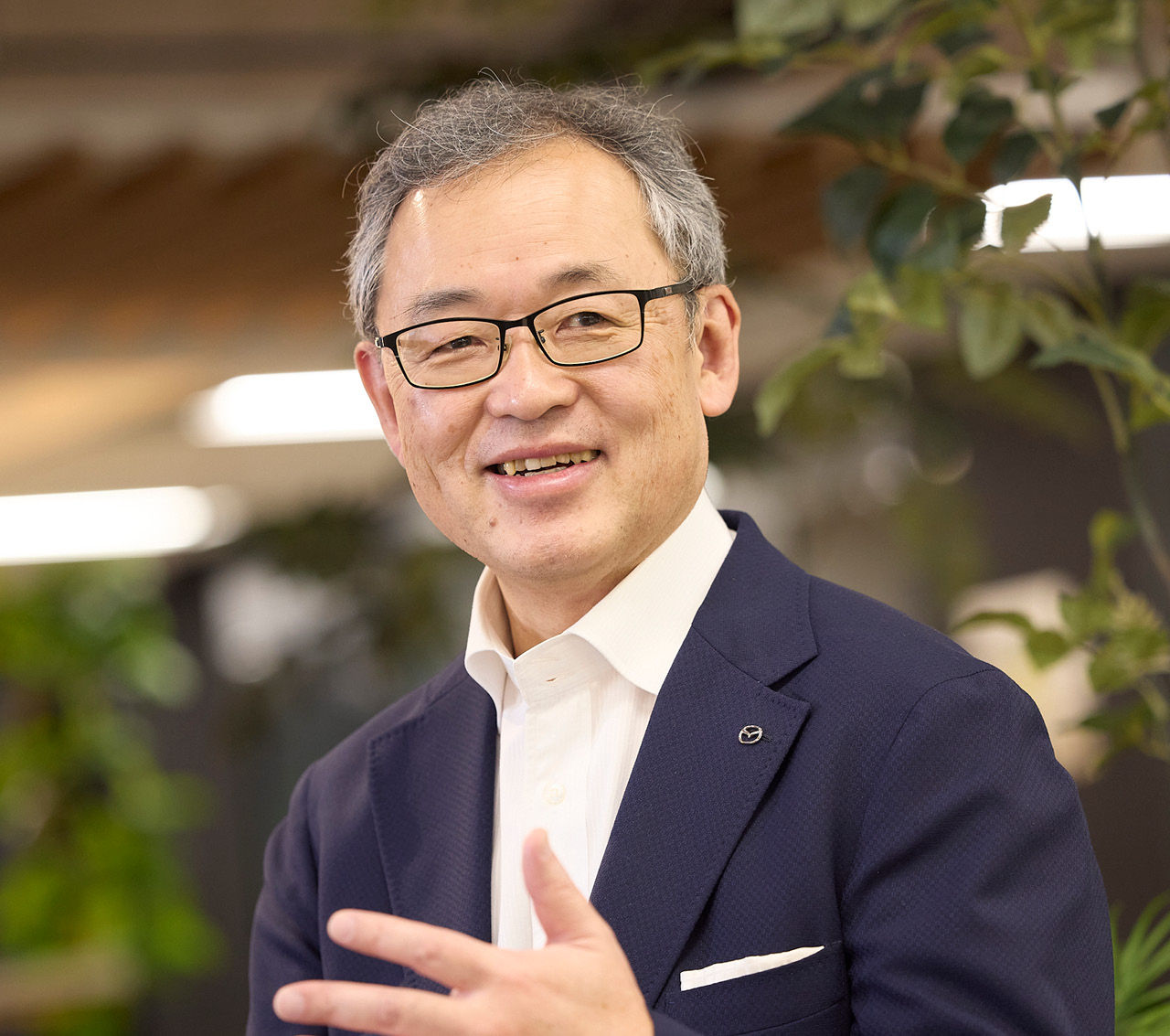
Kazuhiko Sumi

Corporate Leadership Executive Officer and

CSCO (Chief Supply Chain Officer)


Highlights


1.  Driving the structural transformation of our supply chain with customer value as our starting point


2.  Simultaneously creating value and increasing competitiveness by working with our business partners to make co-creation part of everyday business


3.  Working with local communities and wider society to build sustainable manufacturing foundations


What is the background, purpose, and direction of the structural transformation of Mazda’s supply chain?

Since joining Mazda, I have worked in procurement, collaborating in Monozukuri with domestic and overseas suppliers, including local suppliers, as well as with development and production divisions. Since April 2026, I have served as the CSCO, with responsibility for the entire supply chain. I believe it is my mission to bring our business partners and the development and production divisions together as one to support Monozukuri that brings customer value to life. To fulfill this mission, we are building a more competitive supply chain capable of consistently supporting high-quality Monozukuri regardless of changes in the business environment.


The business environment surrounding the automotive supply chain is becoming significantly more complex and volatile due to geopolitical risks, rising raw material prices, regulatory requirements, and advances in electrification and vehicle intelligence. At the same time, digitalization and the growing role of software are transforming the value chain from a vertically integrated model to one based on horizontal specialization, meaning we can no longer maintain global competitiveness by continuing along the same path we have taken thus far.


At Mazda, our goal is to continue refining the unique value we offer and improve capital efficiency so that we can sustainably enhance corporate value through Brand Value Management, even in highly uncertain times. In the area I oversee, I believe we must change the way we think about the supply chain. Instead of seeing it as simply a parts supply network or a means of reducing costs, we need to view it as a foundation for creating customer value and build a supply chain that reliably generates profit. By profit, I do not mean financial results alone. We also consider remaining a brand that is chosen by customers and growing alongside our business partners as important forms of profit that contribute to our future corporate value. We are therefore moving beyond entirely in-house Monozukuri, and are working to optimize our supply and value chains as a whole. Our goal is to increase global competitiveness by restructuring our supply chain to reduce costs and be able to withstand lower production levels.


Specifically, our efforts are built on four pillars:

(1) reducing the number of part variants;

(2) near-site production;

(3) utilizing existing assets; and

(4) thoroughly eliminating irregularity, overburden, and waste.

At the core of these efforts is making co-creation part of everyday business, an approach grounded in long-term, robust relationships of trust with business partners who share our values. The co-creation we aim for goes beyond the optimization of individual parts. It means drawing on our business partners’ expertise from the earliest stages of development and creating customer value from a whole-vehicle perspective. These efforts are enabling more streamlined and efficient Monozukuri throughout the supply chain. As a result, we are both reducing costs and increasing customer value.
What results and progress have you seen from structural transformation of the supply chain thus far?

I believe co-creation is something that multiplies value rather than simply adding it. Structural transformation of our supply chain is beginning to generate new value as we fuse our Monozukuri capabilities with the expertise of our business partners.


During development of the All-New Mazda CX-5, co-creation with Nippon Steel Corporation enabled the fusion of expertise in materials and vehicle development from the earliest stages of development. As a result, we were able to use 10% less steel than for the previous model while also reducing process waste. In addition, “Team Door,” a co-creation initiative with multiple door parts manufacturers, is bringing participants together from the earliest stages of development to pool their expertise to develop door specifications that balance performance with productivity. This initiative is helping us move from optimizing individual parts to a process that identifies the optimal solution for the door as a whole with the aim of reducing development and production preparation lead times while building in quality at an early stage. In our co-creation with Yazaki Corporation on wire harnesses, we pooled our expertise early on in development to rethink parts specifications and structures. This enabled us to achieve near-site production of these parts—something previously considered difficult for labor-intensive manufacturing. On top of this, we were able to thoroughly eliminate irregularity, overburden, and waste across the entire supply chain and establish a framework that can respond flexibly to change.


The value of this type of co-creation extends beyond technological development and cost improvements: it lies in people and companies who share common values working together to create new value. When we combine our strengths and expertise in pursuit of the shared goal of creating customer value, we are able to come up with ideas and take on challenges that we could not take on alone. Co-creation is, in essence, Brand Value Management. I believe that creating value beyond existing boundaries gives us the competitive strength to build a brand that will continue to be chosen by customers.


As the CSCO, what are your thoughts on Mazda’s local communities, and why are they important?

Mazda’s supply chain extends around the globe, but its roots remain in Hiroshima and Yamaguchi—communities that have nurtured us since our founding. Mazda has faced many hardships over its more than 100 years of history, and our local business partners and communities have supported us through each of these challenges. I firmly believe that Mazda’s sustainable growth depends on supporting and being supported by these communities through co-creation and collaboration.


Our local business partners possess valuable assets, including the equipment, technologies, and expertise that have long supported our Monozukuri. Alongside our local partners, we are working to make maximum use of these as we seek to utilize existing assets (3), thoroughly eliminate irregularity, overburden, and waste (4), and bring related production activities closer to our own production sites through near-site production (2). Near-site production involves bringing related production activities closer to our own production sites, reducing transportation burden and enabling us to reduce inventory while strengthening business continuity planning. It also helps sustain and further develop regional manufacturing foundations. We are also using AI and labor-saving technologies to address workforce shortages while helping pass on to the next generation the technologies and expertise accumulated in our communities.


I believe co-creation with our communities generates important social value. It not only makes each participating company more competitive but also helps carry regional manufacturing foundations into the future and enhance Japan’s industrial competitiveness and economic vitality. Mazda has set metrics and targets of annual domestic production of at least 700,000 units in FY March 2031 as well as a 25% increase in the labor productivity of local business partners by 2035 compared with 2026. To achieve these goals, we will work with our business partners to enhance the resilience of our supply chain.


As CSCO, I will continue working with our business partners to advance structural transformation of our supply chain, consistently deliver high-quality products regardless of changes in the external business environment, build a brand that continues to be chosen by customers, enhance our corporate value, and contribute to the advancement of Monozukuri in Japan.