The goal was not just to reduce weight and cost. It was to find out how to deliver real value to customers, in the form of driving performance and safety. Our editorial team spoke with the people behind the all-new CX-5 to trace this journey, and to explore what this kind of co-creation could mean for the supply chain as a whole.
2026.09.11
The Circle of Co-Creation: How Nippon Steel and Mazda Reimagined Car-Making with the All-New Mazda CX-5

×
[8 minutes]
For the all-new Mazda CX-5, steelmaker Nippon Steel and Mazda pushed past the traditional buyer-supplier relationship with a commitment to co-creation. Throughout the project, people at every level set aside the usual formality between supplier and automaker and treated each other as equal partners, not as vendor and client. From the earliest stage of development, both companies shared challenges and thought together about the value they could create in the car. It was a completely new approach for both companies.
"Let's Build a Great Car, Together." Working as One from the Start
The all-new CX-5 unveiling event at Nippon Steel's Kyushu Works, Yawata Area. As executives from Nippon Steel and Mazda signed the white body, the symbol of this co-creation, the room erupted in applause, and team members from both companies celebrated the birth of a new car together.
The city of Yawata has long been synonymous with steel, and with Japanese manufacturing itself. It was a fitting location, then, for Mazda and Nippon Steel to hold the unveiling event for the all-new CX-5. Team members and executives from both companies gathered to share in the joy of a new car born from co-creation.
What our editorial team saw went beyond a finished car reveal. It was the pride and energy both companies' teams brought to building it.
For this feature, we spoke with four people involved in the project: Yasuhiro Shibuya, from the Materials Purchasing Department, who launched the co-creation project; Shinya Nakano, from production engineering, who led the introduction of mass-production equipment; Mitsuru Wakabayashi , who drew on his expertise in body design and lightweighting to drive development forward; and Nippon Steel's Hideaki Suda, who led the day-to-day work on Nippon Steel's side. Each of them approached the same goal from a different position. Through their words, we trace how this co-creation began and what it changed.
Shibuya:
Mazda has always worked to reduce body weight while maintaining high safety standards, in order to deliver the joy of driving to our customers. Advancing that joy of driving, and bringing down costs so our cars stay within customers' reach, have always gone hand in hand.
But the environment surrounding both the automotive and steel industries has changed dramatically, driven in part by the shift toward carbon neutrality. Cost reduction methods that simply extended what we'd always done were no longer enough to bring costs down in any fundamental way. That's where this co-creation project began.

Yasuhiro Shibuya, General Manager, Materials Purchasing Department. At the time of the 2022 co-creation project, he handled steel material procurement as a manager within the Materials Group. As the procurement environment shifted dramatically, he moved beyond the traditional approach of choosing suppliers panel by panel and proposed a co-creation project in which Nippon Steel and Mazda would pool their expertise from the earliest stage of development. He worked with the relevant departments at both companies to get the project off the ground.
We kept coming back to the same problem: how to achieve the performance we wanted while also cutting costs. We debated it as a team nearly every week, without finding an answer. Then one day, it struck me. We'd shared decades of technical exchange with Nippon Steel. Maybe we could move beyond our usual thinking and work with them to rethink cost reduction across an entire car.
If we could bring Nippon Steel's deep expertise in steel into the car-making process, we might achieve a lighter body at lower cost than we ever could by simply specifying steel grades ourselves, the way we always had.
If we worked together from the development stage for the next CX-5, Mazda could deepen its understanding of steel, and Nippon Steel could deepen its understanding of car-making. By helping each other grow expertise in our own fields, I believed we could build a genuine win-win relationship between our two companies.
Nakano:
When I heard this idea, as someone in production engineering, my first thought was that it sounded like it would cause more problems than it solved. We still had to bring costs down in the end, and I couldn't picture where those savings would come from.

Shinya Nakano, Body Engineering Department. He handles production engineering, partnering with the Development Department on vehicle structure and part geometry to connect the finished design to stable production that balances quality and cost. In this co-creation project, he worked with Nippon Steel to explore new materials and production methods, and to solve the challenges of bringing them to mass production.
Wakabayashi:
I felt the same way as Nakano. Narrowing down to one material supplier simply meant fewer design options. My first concern was that losing access to materials from other suppliers might end up making the body heavier, not lighter.

Mitsuru Wakabayashi, KURUMA Development Division. Drawing on his experience in body design and lightweighting technology development, he served as the development-side liaison connecting engineers at Nippon Steel and Mazda. He helped build an environment where both companies could share challenges from the earliest stage of development and bring their respective expertise to the all-new CX-5.
Shibuya:
The reaction throughout Mazda was similar. We didn't yet have a clear answer for exactly what to do or how to proceed. But Nippon Steel and Mazda had a relationship going back more than 40 years, through Nippon Steel's earlier names, Nippon Steel & Sumitomo Metal and, before that, Nippon Steel and Sumitomo Metal Industries separately. We'd kept up technical exchanges throughout. So I had a hunch: if Nippon Steel, the experts in steel, and Mazda, the experts in cars, could bring our knowledge together from the planning stage, we could develop better technology together and design a more optimal body structure. We decided to make that happen with the next CX-5.
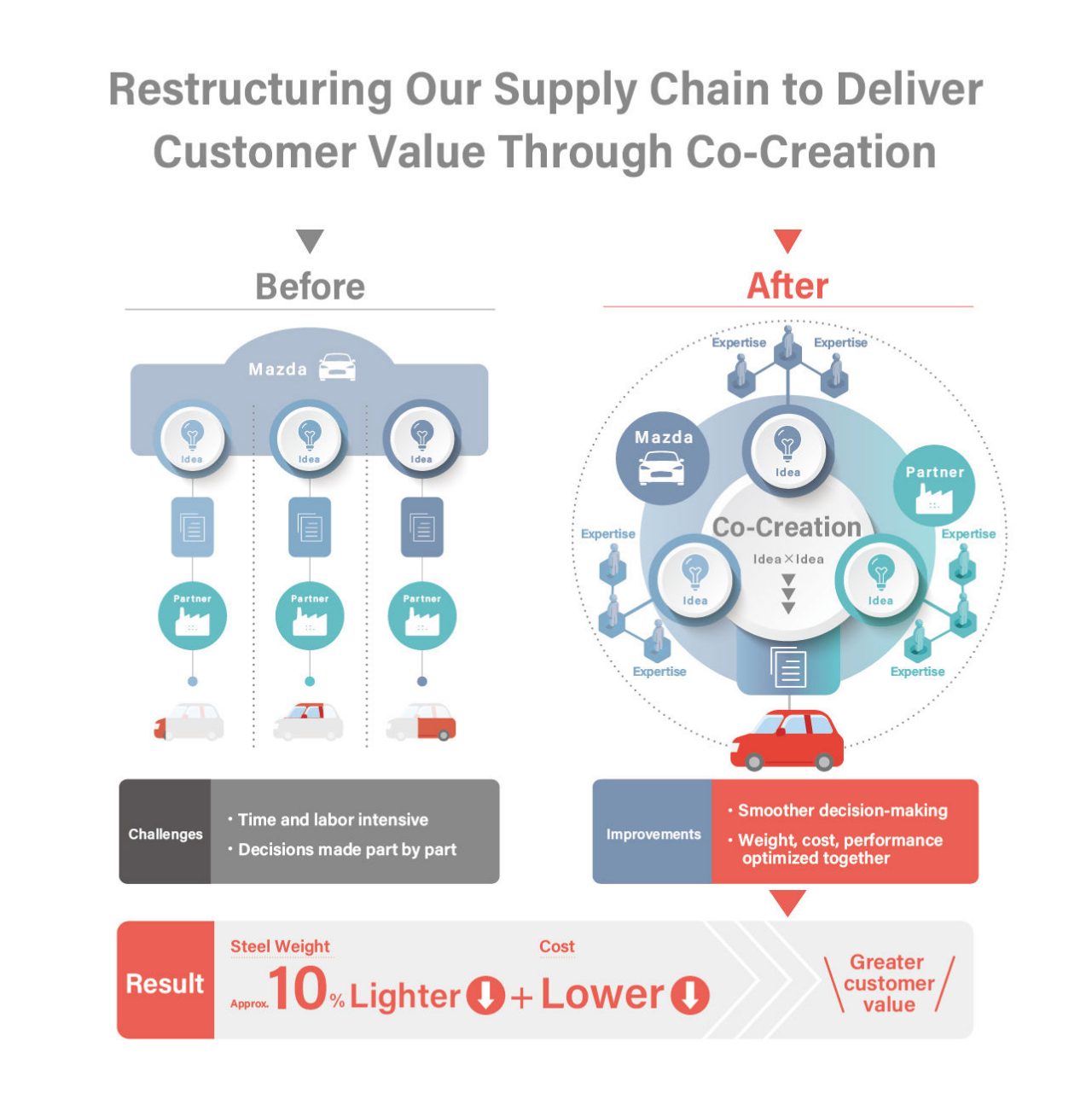
But this was a completely new approach. In the past, Mazda, as the automaker, would decide the body structure, parts, and panel thickness, finalize the drawings, get quotes on every steel panel, and then choose a supplier. This time, we worked with Nippon Steel from the earliest planning stage to optimize the body structure together. We were changing the process itself.
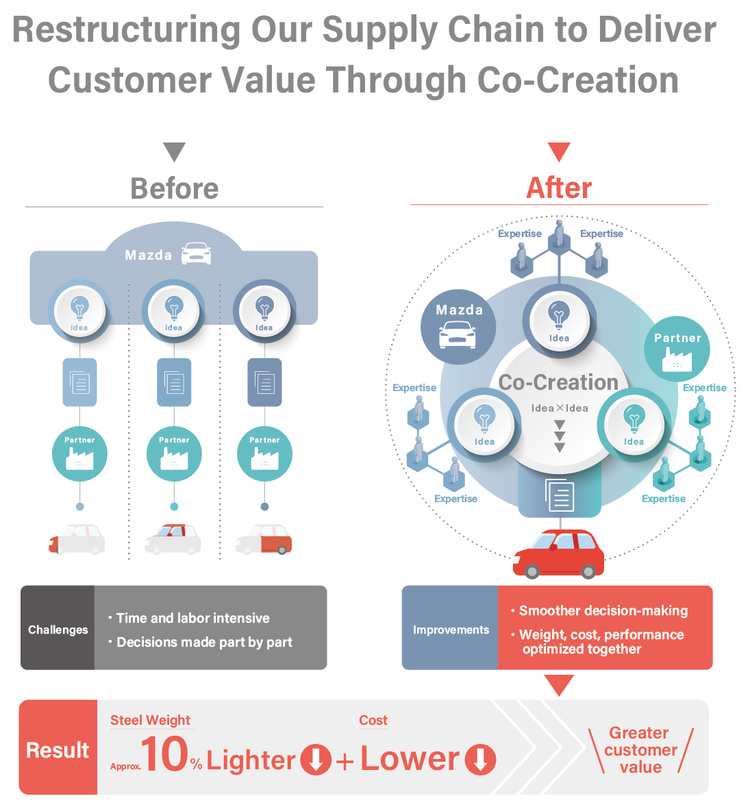
When I brought this idea to our executives, it happened to align with a period when Mazda was already pushing to restructure its supply chain more broadly. They saw it as an interesting idea and told us to start right away, giving the project strong backing from the outset.
The Pursuit of Lighter, Stronger, and More Enjoyable Driving
Nakano:
We already knew Nippon Steel had plenty of technical ideas to offer. But under our old process of deciding the body specifications first and ordering materials after, there wasn't enough time to bring that technology into mass production, and adopting it often meant changing factory equipment, too. That made it difficult from both a timing and a budget standpoint.
This time, we decided to work together from the planning stage, and both companies could discuss from day one which technologies to bring in to cut weight and cost. That meant our production side had time to get ready before development was even finished.

Wakabayashi:
For the all-new CX-5, we're using a world-first high-strength steel developed by Nippon Steel in the bumper reinforcement, a key part that absorbs impact in a collision. That's something we could only achieve because of this co-creation project. Along the way, Nippon Steel shared their technologies with us openly, and it meant a great deal that our designers could approach development with real motivation, knowing exactly which technology they were building with.

From the earliest stage of development, the two companies worked as one team, refining a design and manufacturing process that made the most of the material's properties.
Co-creation did not just broaden Mazda's approach to car-making. By joining in from the earliest stage of development, Nippon Steel also gained a new perspective and a new sense of what was possible. We asked Suda of Nippon Steel, who led this project on Nippon Steel's side, how he experienced this collaboration.
Suda (Nippon Steel):
When I first heard about the project, I was honestly surprised. I wondered if something like this was really possible. We'd wanted to pursue this kind of co-creation before, but contracts and confidentiality concerns always made it hard to take the first step. Mazda opening that door to us this time was a real turning point.

Hideaki Suda, General Manager, Chugoku Office, Nippon Steel Corporation. He led the day-to-day work of this project on Nippon Steel's side, connecting the company's internal technology and research divisions with Mazda. He supported this cross-departmental co-creation project across everything from materials, structure, and production methods to supply chain improvement.
For a business partner like ourselves, being given access to a car while it was still in the planning stage was something that had never happened before. It means a great deal to us that Mazda chose to move past the old framework to truly partner on the project. This wasn't limited to a single part or a single technology. It began with an invitation to build a great car together and grew into something bigger than weight and cost targets: a shared philosophy, aimed at a genuine win for both companies.
This was uncharted territory for both companies, so agreeing early on what they wanted to achieve was more important than ever. Rather than treating this as just a technical review or cost-cutting exercise, the real question was how to enhance the car's value. Co-creation began in earnest once that shared purpose was in place.
From Buyer and Supplier to One Team, One Goal
Shibuya:
To start this project, the two companies wrote a joint proposal. In it, we set out our shared philosophy in one line: "United in purpose to take on an industry first." Starting with that shared philosophy clearly in place was, I think, part of what made this project unique. From there, we discussed what we actually wanted to achieve, and set a clear numerical target: cut steel weight by 10%, no matter what. But the goal was never just weight and cost. It was how to achieve both lightweighting and cost reduction together, and use that to build a car our customers would genuinely love. That 10% steel weight target became the shared goal that carried that larger purpose. It wasn't an easy target. But we weren't chasing weight reduction for its own sake. We were chasing the value it created for customers. And because we set that target ourselves, we were determined to see it through to the end.

Nakano:
We ran the numbers again and again, trying to figure out how to get there. Hitting 10% meant we had to turn those numbers into reality. That's how it started.

Members of both companies faced the same goal together, crossing across company, department, and job title. A relationship built around asking "how" instead of "if" carried this new challenge forward.
Shibuya:
We made a point, in every setting, of moving past the roles of business partner and automaker, and facing challenges as one team united by a shared ambition and purpose. To do that, we changed how we ran meetings, how we set up the room, and how team members on both sides approached co-creation itself. I think that was one of the biggest turning points.
One symbolic moment was how we reported progress to senior management. Instead of the two companies sitting across from each other, we sat around the same table, facing the same direction. That naturally created a shared sense that we were facing the same technical challenges and the same 10% weight target together, not facing each other. It created a shared resolve to clear that hurdle together, as one team.
Nakano:
Beyond body structure, Nippon Steel proposed a range of production methods from a production engineering standpoint to help reduce steel weight. We'd toured their dies and press equipment before and come away impressed, but always concluded mass production wasn't realistic, and left it there. This time, instead of starting from what we thought was possible in mass production, we asked how we could apply their current technology to hit that 10% target. We worked backward from there, identifying what needed to happen and bringing Nippon Steel's own production methods into our mass-production process. You really got a sense that everyone was in it together, determined to clear these constraints as one team.

Wakabayashi:
On the development side, there was a lot we'd wanted to try before but couldn't, things that were out of reach with our own technology and equipment alone. Working through each challenge with Nippon Steel let us push toward that target step by step. Building up those wins gave us the confidence to explore ideas we might once have hesitated on, even ones that seemed unrealistic at first. I think that's helped build this culture at Mazda of people proactively working together to figure out how to make things happen. A lot of that came from Nippon Steel bridging the gap between our development and production engineering teams.

Suda (Nippon Steel):
This time, our involvement in the car's design and development process went much deeper than before. It gave us real insight into which proposals mattered at which stage, proposals that genuinely served Mazda's needs, ones we could truly call meaningful for Mazda. In the past, our proposals mostly centered on materials for individual parts. This time, from the earliest stage of development, we discussed not just materials but structure and production methods together, and worked on technology that delivered the value customers actually need, from weight and cost reduction to rigidity and ride comfort. This experience will reshape the way we think about technology development at Nippon Steel from here on.

Seeing our engineers tackle development with real excitement, I could sense their growth, and I think that comes from starting to see the customer clearly, not just the technology in front of them. In this co-creation project, we were also able to work together on optimizing the supply chain as a whole, and discuss cutting waste and inefficiency at every stage. That, too, was a real source of value.

Members of Nippon Steel and Mazda gather around the all-new CX-5's white body. Bringing their respective expertise in steel and cars together, they pushed past the boundaries of materials, structure, and production methods to build a better car.
Overcoming Constraints to Creating Customer Value Together
Shibuya:
This co-creation project with Nippon Steel is a major benchmark for how Mazda builds cars going forward. The more projects like this we take on, the more value we can deliver to customers. Our car-making grows stronger, and so does our competitiveness as a company. I want to keep building on what we did here and expand it further. Working together from the earliest stage of development let us hit our 10% steel weight target, cut both weight and cost, and deliver real results. But the value goes beyond the numbers. Both companies worked as one team to turn those results into a car our customers would love, and we deepened our trust with Nippon Steel at every level. That means more than anything. Saying "we built this car together" is not a platitude. It's a fact, and something I'm genuinely proud of.

Nakano:
Nippon Steel doesn't just have strong material technology. They're also skilled in production methods and software. If we can combine that with everything Mazda has learned about what makes customers happy, I think we can build cars unlike anything we've made before.
Through this co-creation project, I realized that, without meaning to, we'd let assumptions about what could be mass-produced limit our own thinking. I doubt I was the only one on the team who felt that. We need to think more freely, and let our ideas grow bigger.
Shibuya:
That shift in mindset might be the real achievement of this whole project.
Nakano:
Being honest with each other about what's difficult, what we're each thinking, and solving it together as a team. That approach, I found, leads to better answers in the end. This was a project that built real relationships and real insight.
Wakabayashi:
Overseas competitors are a real threat to Japanese manufacturing. That's exactly why I want to keep building cars while strengthening our relationships with partners across the industry, through co-creation. I'd like to keep growing that circle of people willing to join us.

Members of Nippon Steel and Mazda gather around the all-new CX-5. The experience of building one car together carries forward into the next car, and the next partners who join the challenge.
From the Editorial Team
What stood out most in this interview was that co-creation was more than a slogan. It shaped every decision and every action on the ground. Both companies shared challenges from the earliest stage of development, and instead of asking why something couldn't be done, they asked how to make it work. That's a new kind of relationship, one that goes beyond the traditional buyer and supplier.
As Mazda and its partners share a common purpose and raise customer value across the entire supply chain, the circle of co-creation born with the all-new CX-5 is set to carry Mazda's car-making even further.