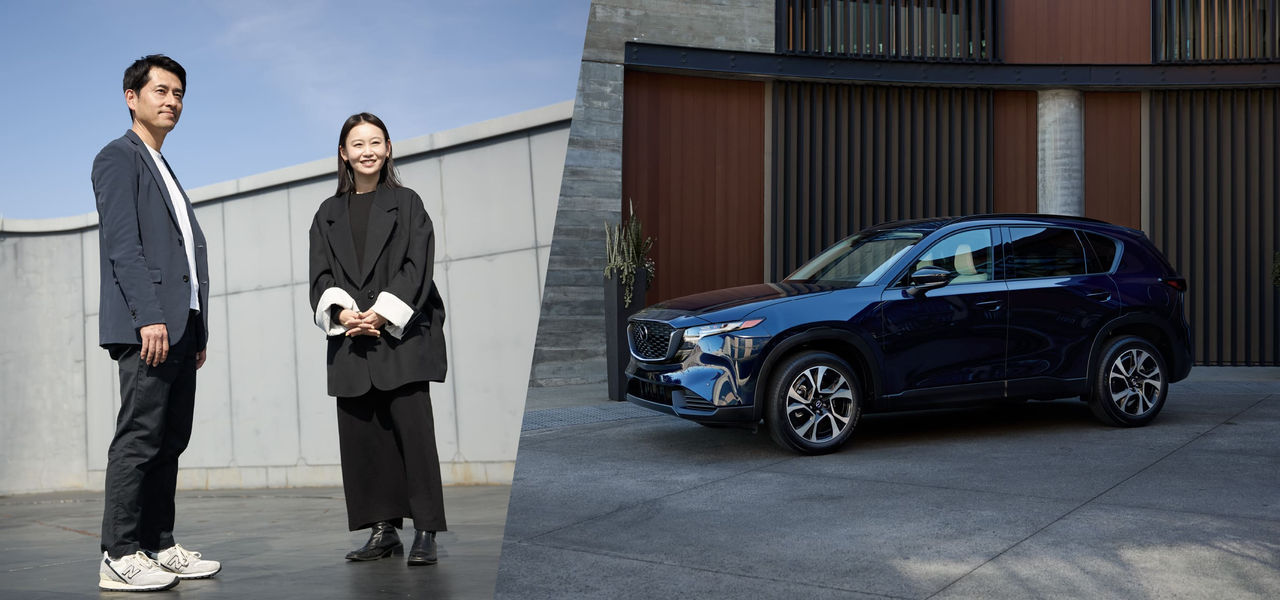
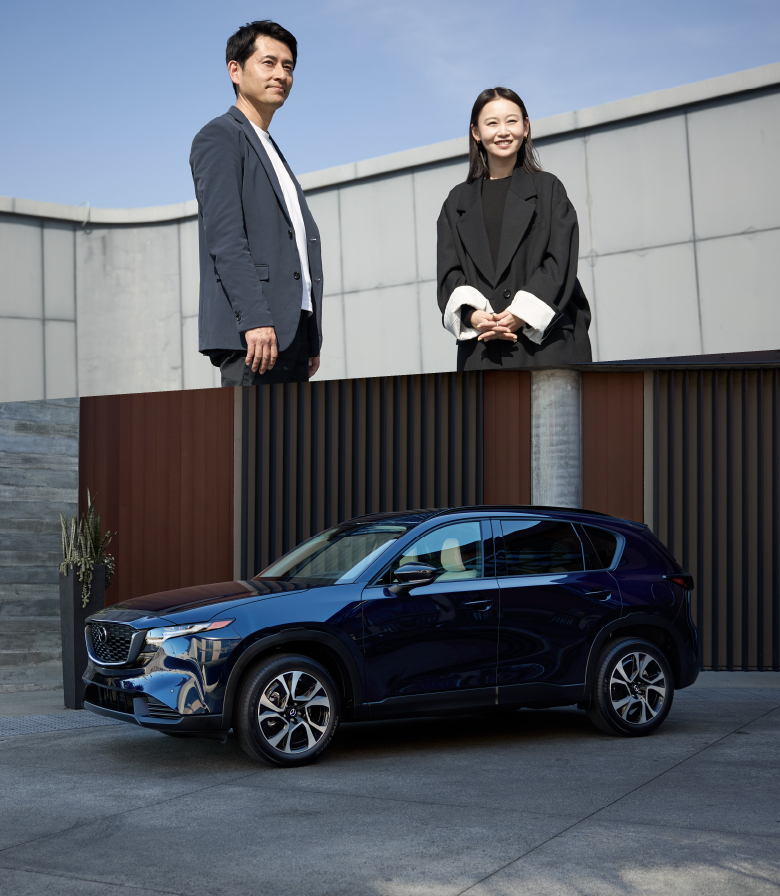
Behind this new blue lies the vision of designers who set out to create a navy that looks beautiful anywhere in the world, in any weather, brought to life through the latest digital technology and the skills of Mazda's paint engineers.
2026.04.24
The All-New CX-5 Navy Blue Mica: How Digital Technology Helped Create a Navy Blue Beautiful Anywhere in the World
×
[3min]
The CX-5 is Mazda's mainstream SUV. Its new color is Navy Blue Mica. This is an evolution of the navy blue that CX-5 customers around the world have loved for years. A new standard color, refined for a new era.
In this conversation, lead color designers Takaba and Murakami, alongside paint engineer Nakamura, share the passion and philosophy that went into developing this new color.
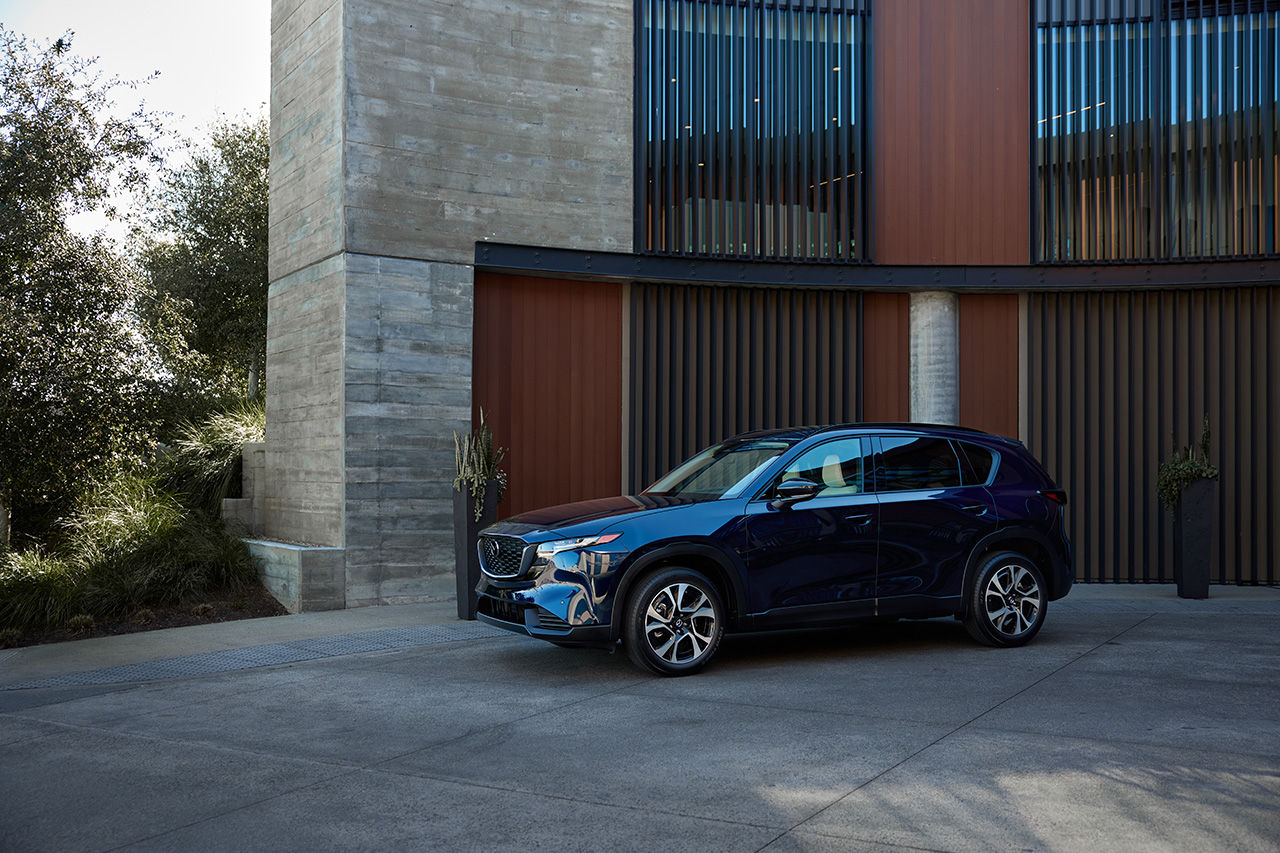
The CX-5 has earned its place as a driver's favorite over many years. Choosing navy blue as the new standard color reflects a belief that has guided Mazda throughout: change what needs to change, and preserve what is timeless.
Mazda's Pursuit of Timeless Beauty through a Standard Color
What was the main reason for choosing navy blue, an existing standard color, as the new color for the long-established CX-5?
Takaba:
It started with a request from Mazda North America. At the time, I was working on several body colors with strong, distinctive characters. The feedback from the North American design team was clear: pushing bold new personalities is important, but so is evolving Mazda's standard colors. Both matter equally.
The predecessor to Navy Blue Mica, Deep Crystal Blue Mica, was created in 2010 when Mazda introduced the Kodo "Soul of Motion" design philosophy. It has been a beloved color ever since. But Kodo design itself has evolved significantly since then. The team felt strongly that the time had come to update the navy and establish a new standard.

Noriaki Takaba, Design Innovation Studio, Design Division. Involved in the Navy Blue development from the very beginning, he secured support across departments and led the digitalization of color development for production vehicles.
Did that request make sense to you intuitively?
Takaba:
It did, once I visited North America myself. Seeing Deep Crystal Blue Mica under California sunlight, the North American team's message clicked immediately. The light there is incomparable to Hiroshima. Under the strong sunshine, the body had a harsh and intense glare that made it read white, quite different from how it read in Japan. That was the moment I knew that this color needs to evolve.
Murakami:
The CX-5 is Mazda's mainstream SUV, chosen by customers around the world. We've always pursued timeless quality, not just in performance and comfort, but in design. A bold, attention-grabbing color might turn heads for a moment, but it doesn't fit what the CX-5 stands for.
Our goal was to deepen the beauty of a classic color, to make something customers would continue to find beautiful in their daily lives. That, we believed, would bring the most value to the CX-5. And so the development began.

Kao Murakami, Design Creation Studio, Design Division. Led the color design for the CX-5 and supported the production of body colors as part of the exterior color development team.
The Challenge of Creating a Navy that is Beautiful in Any Place or Weather
What challenges did you face in developing Navy Blue Mica?
Takaba:
Our first goal was to make sure the color read clearly as navy even in strong light, California-strength light. We worked to make the highlights sharper and more precise, and to take away that harsh, glaring quality.
But when we applied the prototype to an actual vehicle, a new problem surfaced. Under overcast skies in Hiroshima, the shadowed areas didn't read as navy at all.
Murakami:
When the European design team saw those results, the response was immediate. In environments like Germany, where autumn and winter skies are often heavy with cloud, highlights alone can't carry the beauty of a color. The blue has to look beautiful even without sunlight. Their conviction was clear, and it reinforced our own: we needed to create a navy that met a global standard.
So meeting that global standard brought new challenges.
Takaba:
Exactly. The new challenge was how to make the shadowed areas read as navy without direct light. How far could we push the saturation? How should the new mica particles be applied to achieve the right depth of color? That was when we decided to consult with paint engineer Nakamura.
Nakamura:
The difficulty was translating the designers' sensory language into physical terms.

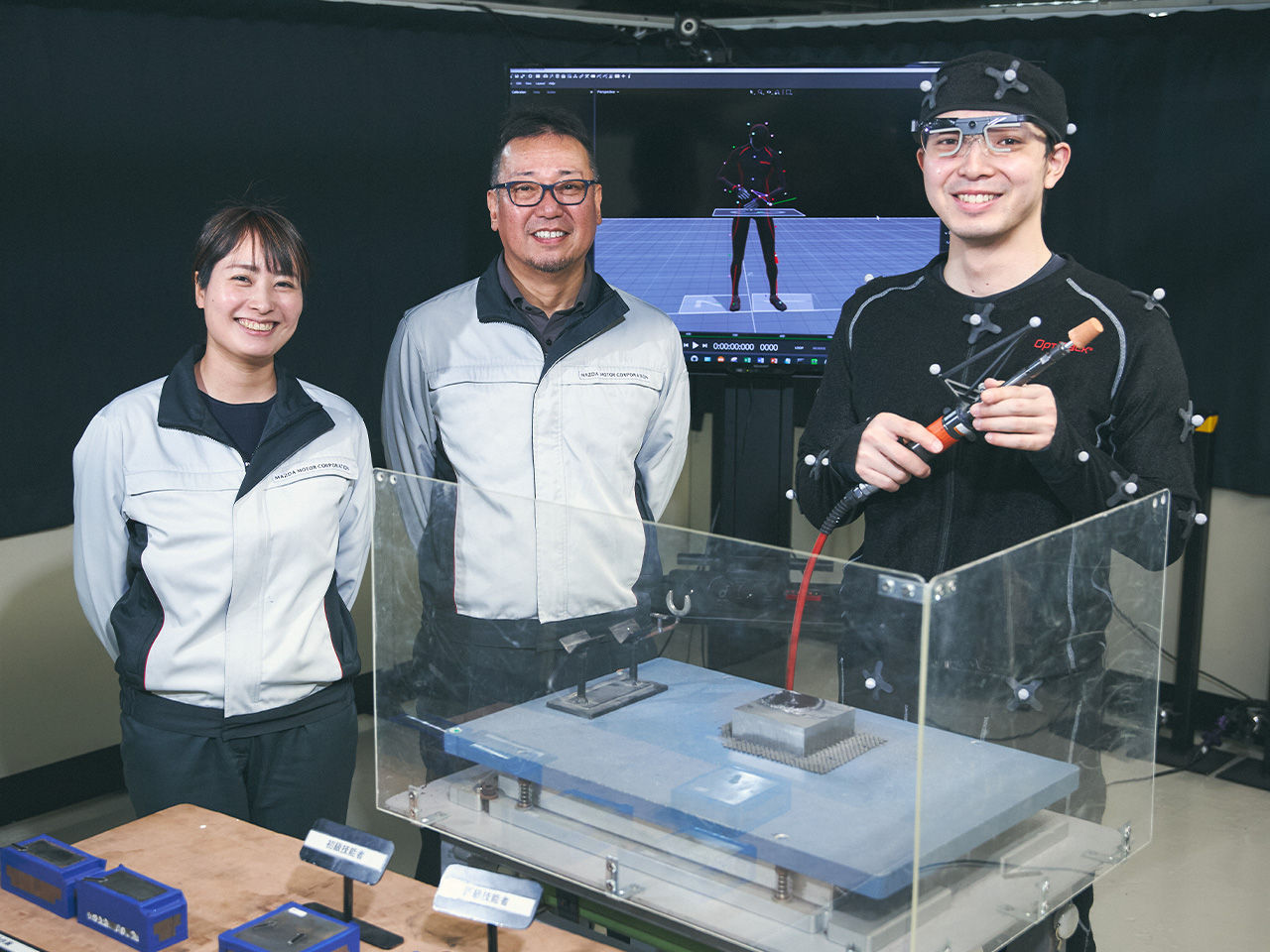
Noriyuki Nakamura, Painting & Plating Engineering Group, Vehicle Engineering Division. His role in the Navy Blue development was to convert the designers' vision into data, then reproduce that digitally created color as an actual, physical paint.
Nakamura:
We had the word "refinement" as a guiding concept, but for a long time I couldn't pin down what that actually meant in physical terms. Through ongoing conversations with Takaba, it gradually became clear.
As an engineer, I came to define "refinement" as this: no unnecessary shimmer at angles where the color should appear dark. Once we had that shared understanding, it was a matter of translating it into physical reality, adjusting paint formulas and application methods until we arrived at the ideal navy.
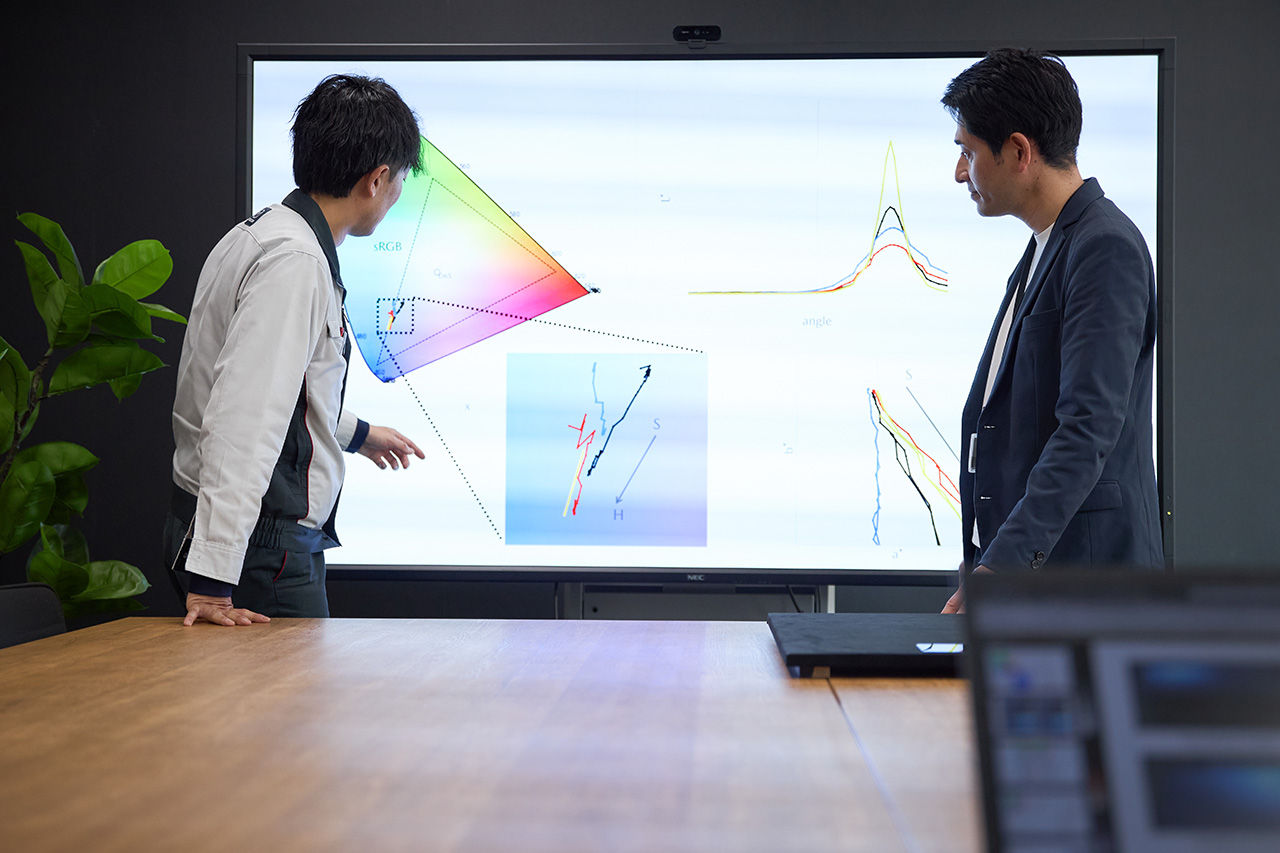
Nakamura (left) and Takaba (right) found a shared definition of "refinement" by converting the concept into measurable data.
Using Digital Technology to Achieve both Vibrancy and Refinement
This development also incorporated a digital approach to color development. What did that look like in practice?
Takaba:
Digital color development at Mazda means converting the designer's vision into data, so designers and engineers can work toward the same goal in a shared language. It's not just about efficiency. It raises the precision of the work, and it means we can get better colors to our customers sooner.
Murakami:
In this project, everything was quantified, the intensity of California's glare, the softer light of an overcast Frankfurt sky. We used images shot by colleagues at our North American and German studios to calibrate our digital environment, recreating those conditions here in Japan. Being able to refine the color against American and European conditions, without leaving Japan, is one of the real advantages of digital development. It's also one of Mazda's strengths: a genuinely global network of studios working together.
From an engineering perspective, where did you find digital development most valuable?
Nakamura:
Having clear, measurable targets. Qualities like vibrancy and refinement, concepts designers express through feeling, could be defined as numerical standards, which gave us something concrete to work toward. Running experiments digitally, based on that data, was equally valuable.
Reaching the ideal within a tight timeline, in time for the CX-5's launch, was made possible largely because digital development reduced the number of physical prototypes we needed to build.
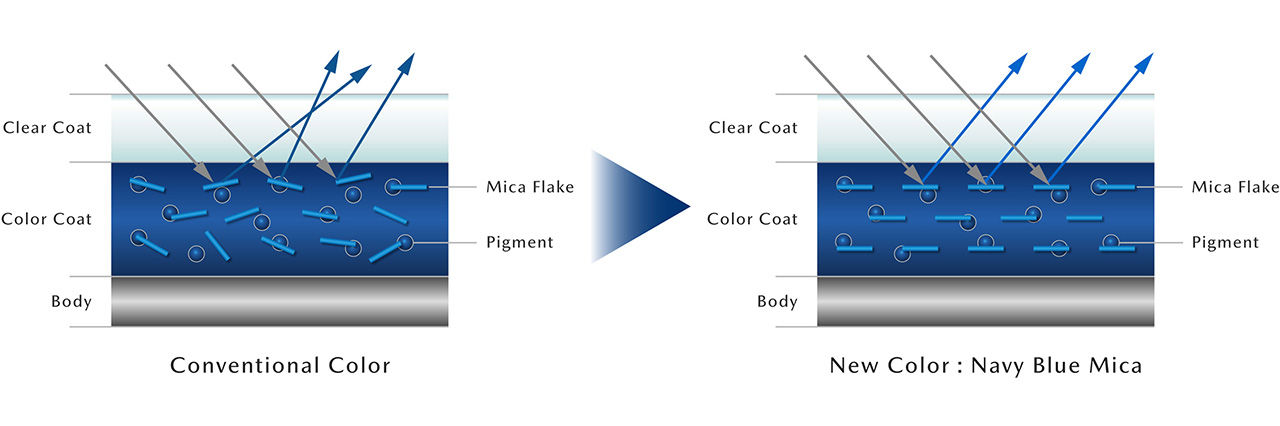
Compared to the previous color (left), the mica particles in Navy Blue Mica (right) are aligned horizontally, reflecting light uniformly in one direction, like a mirror.
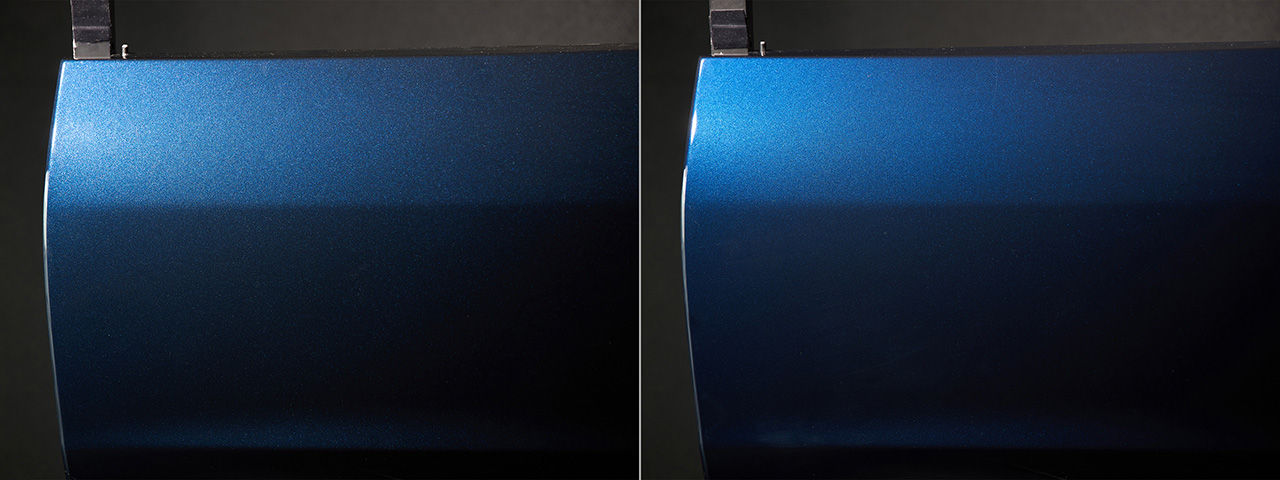
Compared to the previous color (left), Navy Blue Mica (right) has no unnecessary shimmer. The result is a composed, refined brilliance with a sense of depth and quality.
When you saw the finished color, what was your reaction?
Takaba:
Even on screen it was beautiful, but when the physical color chip came out, I felt a genuine surge of emotion. Thanks to the engineers' dedication, we achieved what I'd describe as high-resolution paint, particle presence reduced to an extreme degree, with a precise, concentrated brilliance. We've created something I'm genuinely proud to call a Mazda standard color.
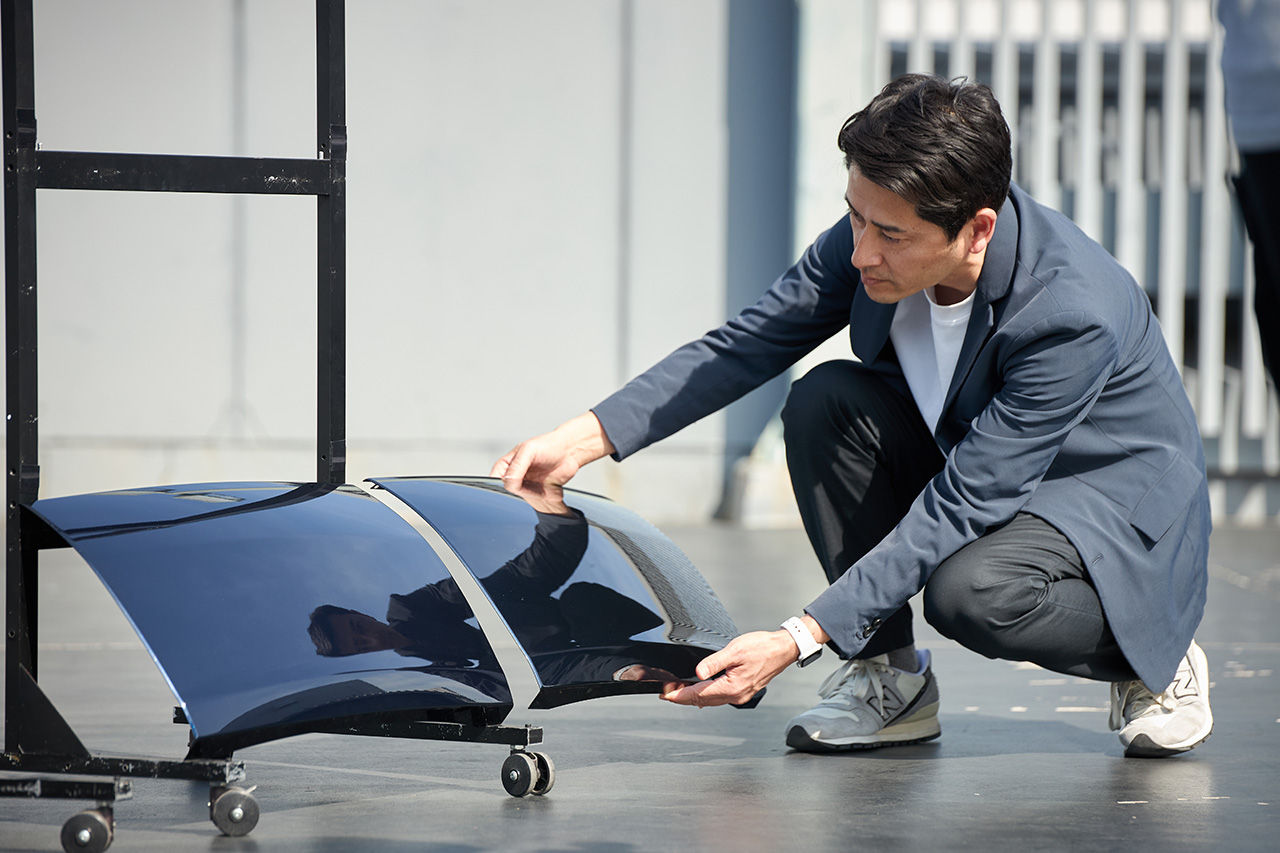
Takaba comparing color chips, previous and new, under the soft Hiroshima light of the Seto Inland Sea.

California sunshine, an overcast Frankfurt sky, or Hiroshima's daylight, this is a navy that can hold its beauty anywhere in the world.
Preserving Timeless Quality and Bringing Moments of Beauty to the Everyday
This project feels like a perfect balance between a designer's desire to push forward and Mazda's commitment to honoring its tradition and values. Would you say that's true?
Murakami:
Yes. Customers who love the CX-5 come to it with certain expectations, a quiet assurance, a timeless quality. Letting them down was never an option. Our challenge was to protect what shouldn't change, while still finding ways to raise the standard. That was the mission. I believe Navy Blue Mica has elevated the CX-5 to a new level.
Takaba:
I developed this color with one hope: that it would bring small moments of delight to people's daily lives. Imagine heading out in the morning and catching a glimpse of your CX-5 in the car park, its navy catching the early light. I hope it's something people find beautiful, day after day, for years to come.

Countless trials went into creating a navy that meets a global standard, beautiful no matter the environment.
Jacques Flynn, Senior Director of Design, Mazda North American Operations
"When it comes to the blue color trends here in the North American market, we've seen a couple of things happening. Colors are becoming more saturated and more vibrant, but also more sophisticated and more refined in their execution. When it came to what the North American Mazda customer was looking for in a new blue, they were looking for something with a higher level of elegance, a bit more sophisticated. When looking at the new Navy Blue Mica under California sunlight, it was important to strike the right balance of beautiful blue hues, but not so intense or harsh that it had a whitening effect in the light. It was a vision that I continued to share with the Japan team.
My first impression when viewing the new Navy Blue Mica on the all-new CX-5 was that the paint felt more sophisticated and more elegant than before. Even under California sunshine, there's no harsh, whitening glare. The depth of shadow and the high-resolution finish really accentuate the vehicle's proportions and surface language. This is exactly how Mazda approaches color, in conjunction with form.
There is a clear connection in this process to the spirit of Japanese craftsmanship and that pursuit of perfection. And this is absolutely in line with Mazda's design philosophy, which is all about that pursuit of perfection. The all-new CX-5 is the first vehicle to receive Navy Blue Mica, and that is significant. The CX-5 is one of our most important vehicles and a key to Mazda's success in North America. Like previous generations of CX-5, we want our customers to instantly feel that timeless quality of the vehicle. Navy Blue Mica helps tell that story."

Jacques Flynn shares how the new color's refinement and elegance stand out, even in the bright California sun.
Alena Gersonde, Senior Designer, Mazda Motor Europe
"In Germany, where we struggle to find sunlight, especially in autumn and winter, highlights alone can't carry the beauty of a color. We wanted to create a timeless navy that could work across time and place, a rich blue shine that eliminates all other colors. It had to look beautiful in any weather.
We were fortunate to work with a group of open-minded, well-traveled and talented color designers in Japan. They have a really good understanding of our struggles and feedback. It made it so much easier to hold firm to our vision.
My first impression of the finished Navy Blue Mica was very positive. The purity of the navy is unmistakable. The very fine particles leave a smooth texture and good contrast, and when the light hits it, it stands out. The shadow and highlight quality was improved and the sculpted form of the CX-5 is beautifully enhanced. Even under the cloudy Frankfurt sky, the color retains that delicate blue brilliance through to the deepest shadows."

Alena Gersonde shares her design story, and how even the overcast Frankfurt sky could not diminish the depth of shadow on the CX-5's sculptural form.
From the Editorial Team
Design, engineering, and a global perspective, brought together through digital technology to create Navy Blue Mica. Speaking with the team, it was clear this color is set to become a new classic in the CX-5's story. One that adds a quiet brilliance to the daily lives of customers around the world.