In 2025, there were 0.21 traffic accident fatalities in Japan per 10,000 Mazda vehicles owned. That is lower than the Japanese manufacturer average of 0.26 and reflects a high level of safety.
2026.10.16
Looking Beyond Safety Ratings: The Mazda Safety Engineers Who Helped Protect a Family's Tomorrow
×
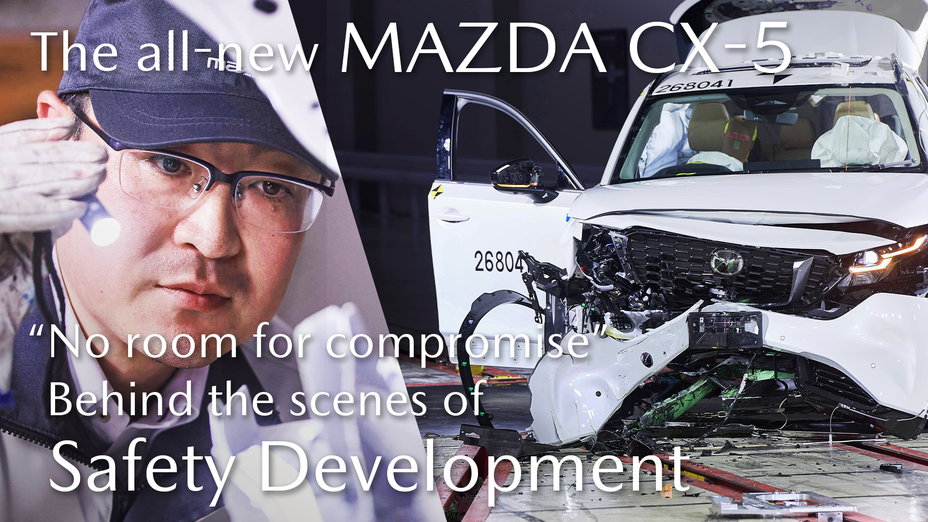
本編映像 [12min]
Mazda envisions a society where everyone can travel safely, and where the joy of driving helps people live full, vibrant lives. To get there, Mazda is steadily advancing its efforts to try to achieve zero fatal accidents by 2040.*1
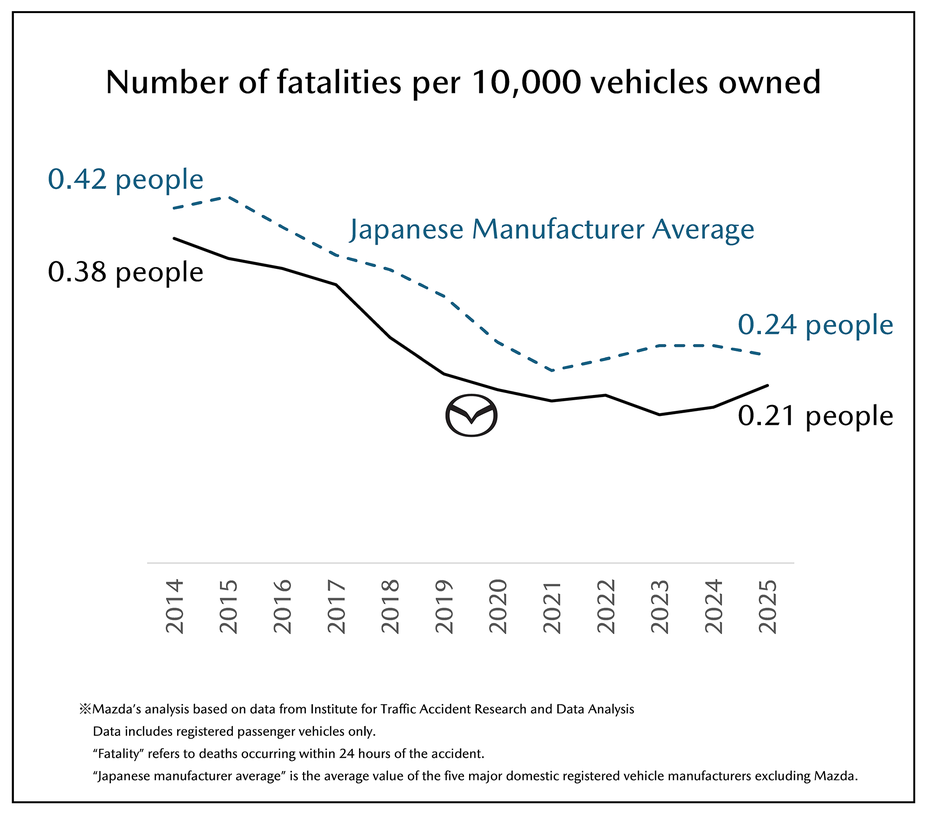
*1 By 2040, where an accident is preventable with automotive technologies, Mazda aims for zero fatal accidents caused by its new vehicles.
In the United States, nine Mazda models, including the all-new Mazda CX-5, earned the 2026 TOP SAFETY PICK+, the highest safety award from the Insurance Institute for Highway Safety*2. It marked the highest number of awarded models for any single brand, demonstrating how Mazda's safety performance is recognized globally. (As of August 2026)

*2 Insurance Institute for Highway Safety (IIHS) (https://www.iihs.org/ratings/top-safety-picks)
But these numbers and ratings do not tell the whole story. Behind them are the lives of the people who ride in Mazda cars, and the families who hope they get home safely.
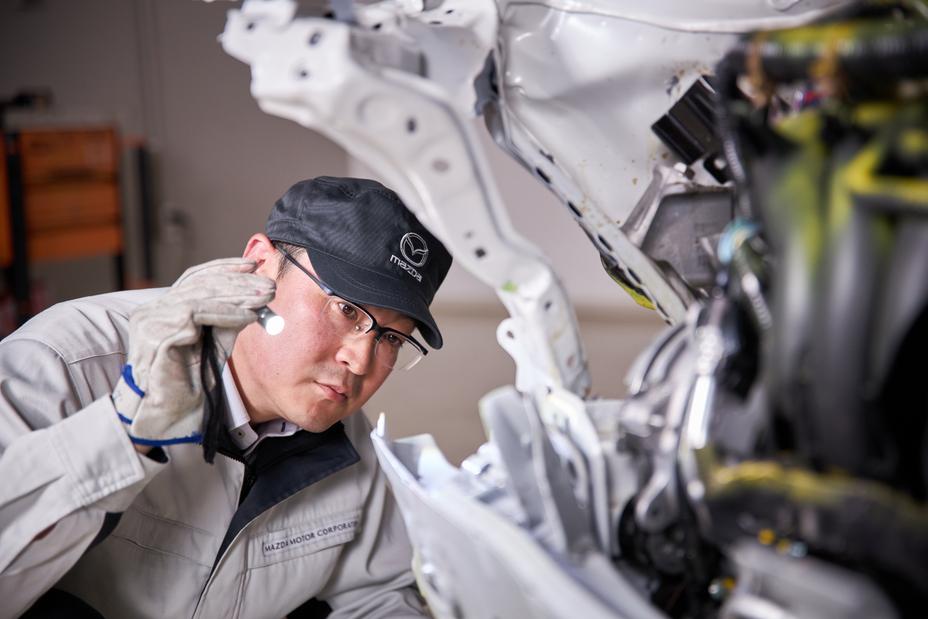
Mazda's engineers keep their focus on the life of every person who gets behind the wheel. We followed the engineers who work on safety every day, and the true story of one life that a Mazda car helped protect.
The Mazda That Helped Protect a Life
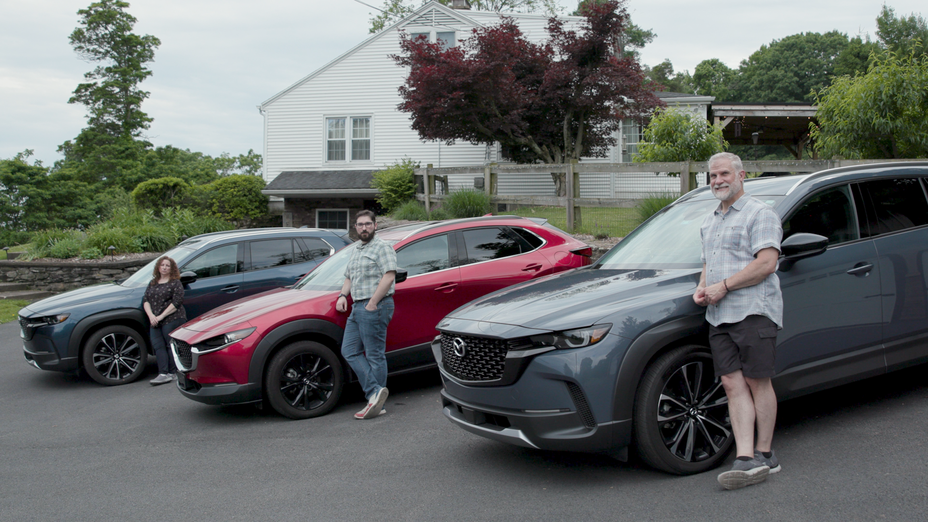
The Polk family lives in Pennsylvania, in the United States. Father Greg, mother Laura, and their eldest son Michael each drive a Mazda, making them a true Mazda family. There is a reason behind this choice. It all began with Michael's car accident.
It was Mother's Day weekend, 2023. Michael was working in New York State at the time. Late at night, after finishing work, he was driving his Mazda CX-30 home to the apartment where he lived alone.
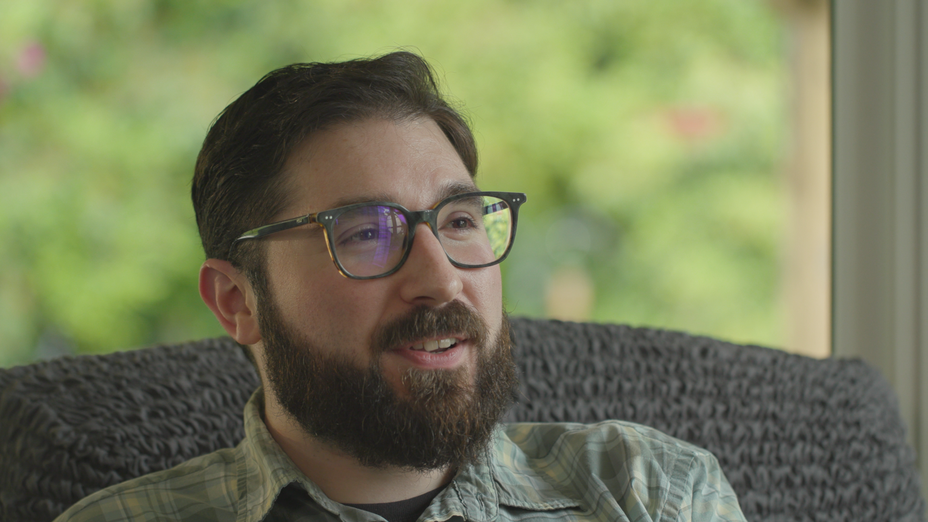
Michael:
That day was a long workday. Driving home was a longer highway, roads that, after a certain point, feel a little bit monotonous, and you almost just zone out a little bit. Unfortunately, this night was one of those nights. You start to feel a little bit groggy after a long day of work. You close your eyes for what feels like a second, and next thing you know, you're waking up to make a 911 call from inside your overturned car, and you have no sense of where you are.
When the accident happened, it was pitch dark. Michael had no idea what had happened and had lost his sense of gravity. He called 911 himself. Still dazed, he was put into an ambulance and taken to the hospital.
Meanwhile, in Pennsylvania, his mother Laura received a phone call from Michael.
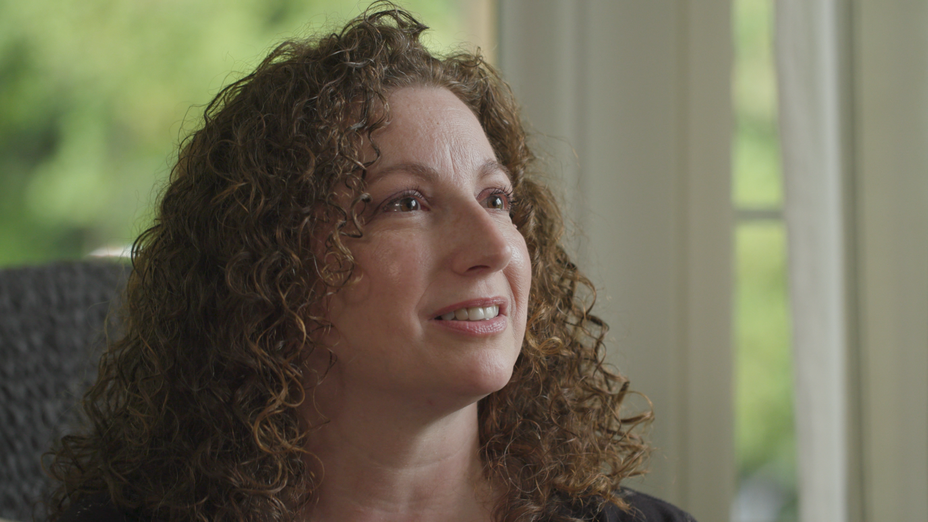
Laura:
When the phone rings at about 12:30 at night, it's never usually a good thing. And thankfully, it was Michael's voice that I heard. It wasn't a police officer or anything like that. It was Michael letting me know that he had been in the accident.
I basically stayed on the phone with him the entire time, which seemed like a lifetime.
As a parent in that moment, you just feel so helpless because you can't just be there with them. He was 2.5 hours away from us at that time. I had to just suck it up, and wait.
When Laura heard that Michael had been discharged, she got in her car and drove straight to his apartment.
Laura:
Once I finally got up to Michael's apartment, he was still in bed. I basically just went into his room and lay there with him for a little bit. As a mom, you just always want the best for your kids. Being able to see him in his own bed, alive. It was good. It was really good.
Michael:
The next thing I remember was getting loaded into the ambulance and being taken to the hospital, getting X-rays, and I literally walked out of the ER four hours after the event, thanks to the car itself.
Apart from bruising around his eye and marks from the seatbelt, Michael had no serious injuries. He could walk on his own and even went to work the day after leaving the hospital.
The next day, when Michael and Laura saw the car, they realized for the first time how serious the accident had been.
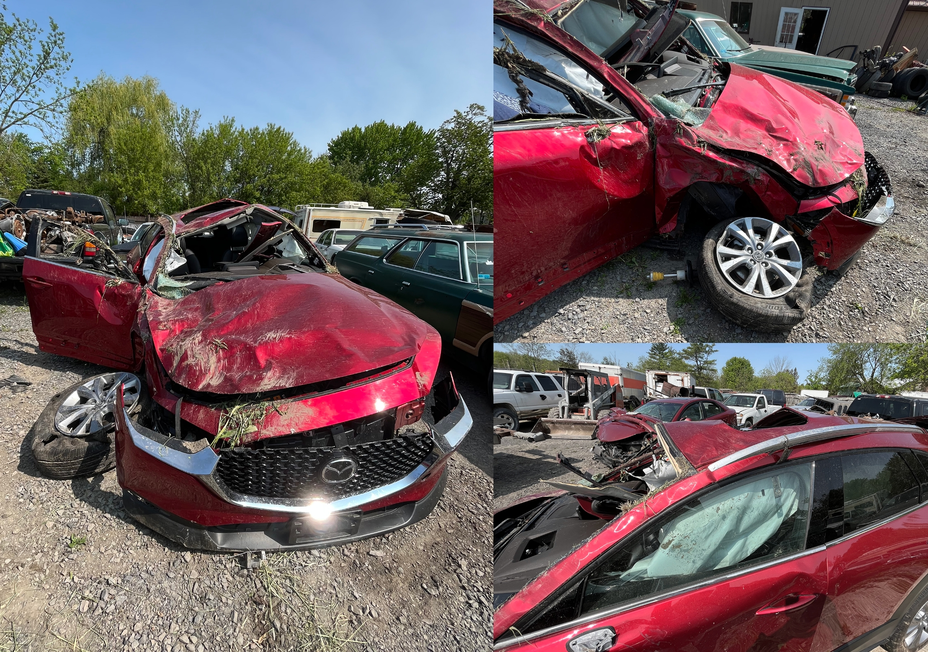
Michael's CX-30. It was late at night and completely dark at the time of the accident, so Michael himself had not realized how badly the car was damaged.
Laura:
Seeing the car was very, very emotional for us. When I had seen the police report, they said that he rolled probably two times. And it was very jarring to know that he had walked away from that scene of carnage. He was standing there next to me, up and walking around and alive. We were very grateful for that.
Michael's Mazda helped protect his life. It was built on a safety philosophy that Mazda's engineers have pursued for many years: aiming for zero fatal accidents not just on paper, but in Real World conditions.
Looking Beyond Top Safety Ratings
Mazda vehicles have earned high marks in safety tests by independent organizations in major markets around the world, including Japan, the United States, Europe, and Australia. Many models have received top ratings.*3
But Takashi Hamada from the Crash Safety Development Department says that high scores are not the goal.
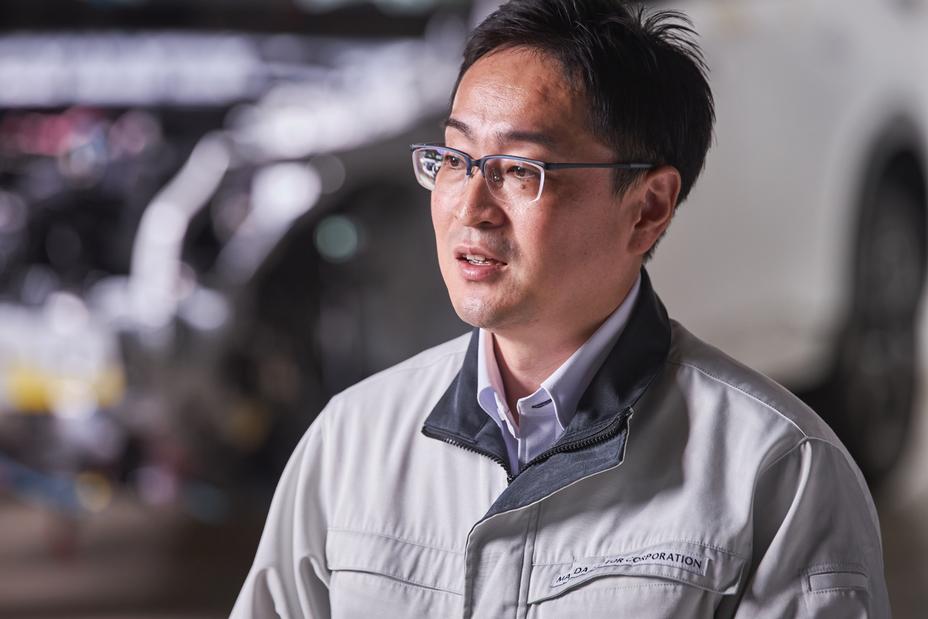
Takashi Hamada, Frontal Crash Safety Development Group, Crash Safety Development Department, KURUMA Development Division. Hamada has worked in crash safety development since joining Mazda and leads crash safety development for the all-new CX-5.
Hamada:
We think of safety as having three tiers. The first is regulations. These are set by law, and a car that doesn't meet them can't be sold. The second is market assessments. These are objective evaluations by independent third parties, such as NCAP and IIHS, that rate a car's safety. But these alone aren't enough, because regulations and assessments don't cover every accident that happens in real life.
Mazda's own safety philosophy is to aim for zero fatal accidents in Real World conditions, meaning under every condition people actually face. Real accidents don't happen under set test conditions. Every situation is different. That's why in development, we don't start from regulations or assessment tests. We recreate and analyze accidents that have actually happened, then ask what technology we need to try to achieve zero fatal accidents in Real World conditions. Meeting assessment and regulatory standards follows from that.
Crash safety performance is something we hope customers never have to experience. But if an accident does happen, we want to provide what we call "true safety performance," which helps minimize harm not only to the occupants but also to people nearby. That's what we work toward every day.
*3 For details on Mazda safety ratings in each market, see here.
https://www.mazda.com/en/innovation/monozukuri/technology/safety/#inno_tec_safe01
Comfortable Driving Leads to Safer Driving
When people think about safety, many picture the moment of an accident. But Mazda's approach to safety starts well before an accident happens.
Mazda Proactive Safety, Mazda's safety philosophy, aims to keep drivers away from risk in the first place, rather than responding after an accident occurs.

Mazda's safety philosophy: Mazda Proactive Safety.
With this in mind, Masayoshi Horiue develops the basic safety technologies that form the foundation of Mazda safety. His starting point is a simple question: what puts people in their optimal state?

Masayoshi Horiue, Craftsmanship Development Group, Vehicle Testing & Research Department, KURUMA Development Division. Drawing on ergonomics and Kansei engineering, Horiue works to create cars that support wellbeing and let people enjoy driving for themselves. For the all-new CX-5, he leads development of the basic safety technologies that underpin Mazda's Joy of Driving philosophy. This includes cabin comfort, ease of getting in and out, driving position, visibility, and a driver-focused Human Machine Interface (HMI)*4 that is easy to see, understand, and operate.
Horiue:
To reduce risk as much as possible, we focus on three elements of the car: a good driving position, clear visibility, and a Human Machine Interface (HMI)*4 that lets drivers concentrate on driving.
Take the driving position, something Mazda cares deeply about. It's often discussed in terms of ease of driving, but it's also an important part of safety.
If your posture is off, you may not correctly perceive what's happening outside the car, or you may make an operating error. Staying less tired on long drives is also very important for reducing human error.

Mazda's driving position. Keeping the driver's joints at natural angles allows them to sit straight in a natural posture.
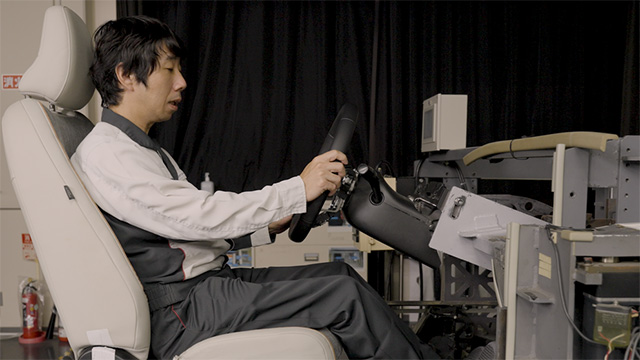
The driving position tester. Despite its age, this is the third generation of this equipment. Though rarely used today, it measured human movement and muscle activity, and helped adjust each position millimeter by millimeter. Using this tester, generations of engineers built up the ideal driving position over time.
In the all-new CX-5, entering your height automatically moves the seat, Active Driving Display, and door mirrors into position. On-screen guidance then helps to fine-tune the seat, steering wheel, and more, making it easier to find a driving position that more closely suits individual needs.
Horiue:
Next is visibility. What matters most is being able to see what lies beyond the structures closest to your eyes, in other words, what's hidden in your blind spots, in all kinds of situations.
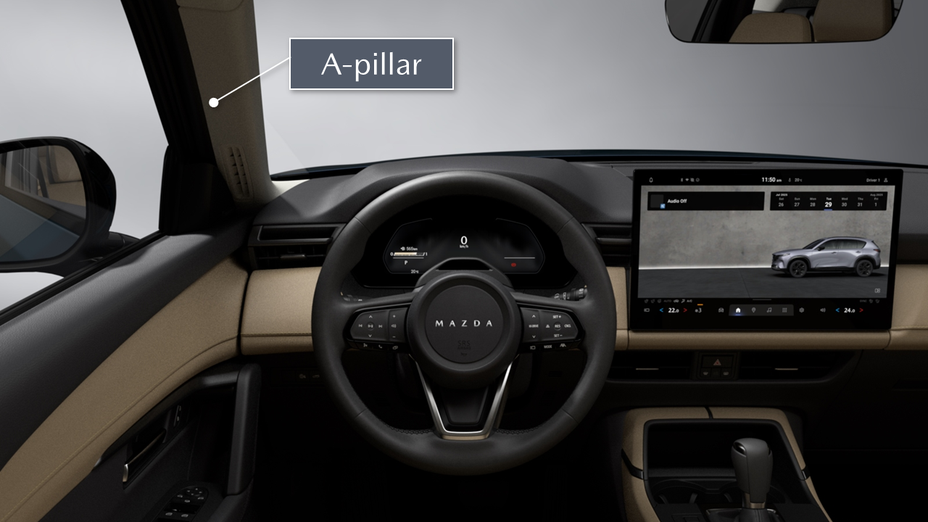
The slimmer A-pillars of the all-new CX-5. Drivers can see through the gap between the pillar and the door mirror without moving their head significantly, improving visibility to the front and diagonally ahead.
Horiue:
Third is an HMI that is easy to see, easy to understand, and easy to operate.
When a driver's attention goes to anything other than driving itself, such as accelerating, turning, and braking, it has a greater effect on how they drive. That's why we place the information needed for driving right in front of the driver, and move everything else to the center display. This creates an environment where drivers can concentrate on driving.
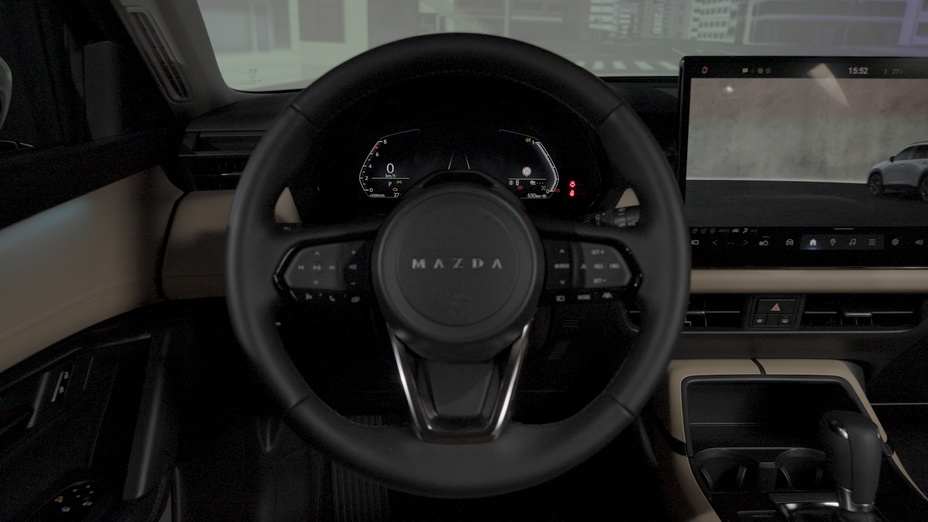
In the all-new CX-5, climate control, navigation, and audio can be operated with switches close at hand or with advanced voice recognition, for an HMI that helps drivers stay focused on the road.
Horiue:
The key is to put the person in an optimal state first, then arrange the car's elements around them. Thinking this way makes driving more enjoyable, and it's also important for safety.
Horiue describes his work as the kind that goes unnoticed.
Horiue:
People notice when something is dangerous. They don't notice when it's not.
Safety is about helping avoid accidents, but it's also about creating peace of mind. I believe people can truly enjoy driving only when they have that peace of mind as a foundation. I want to keep improving my skills and build cars that let people feel at ease, and enjoy driving because of it.
*4 Human Machine Interface (HMI) is the collective term for devices and software that allow people and cars to exchange information.
The Last Line of Defense to Help Protect Lives
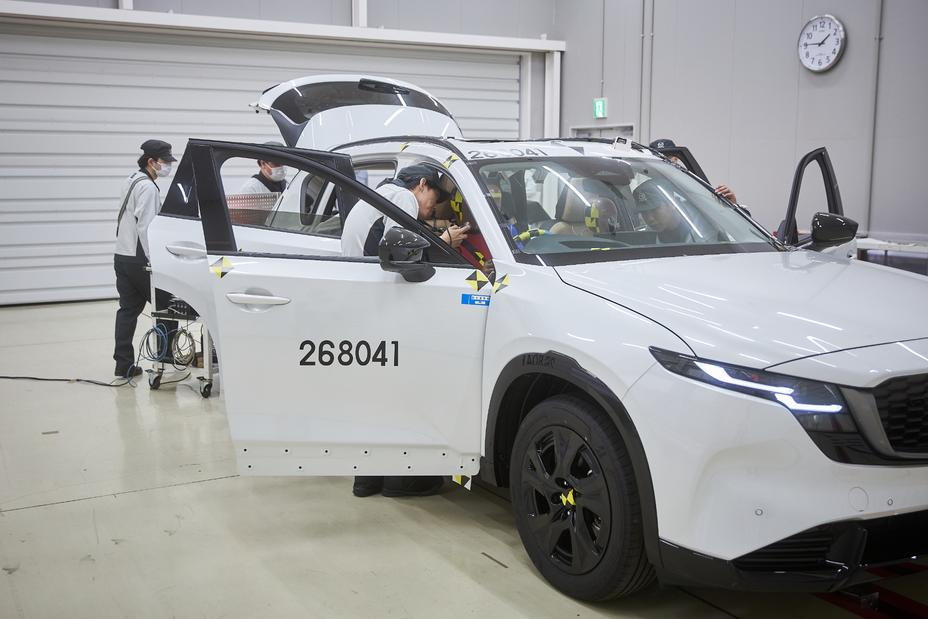
At the Mazda Miyoshi Proving Ground, the team conducts a frontal crash test of the all-new CX-5. According to Hamada, the challenge of crash safety performance development is balancing safety with many other factors.
Hamada:
Improving safety doesn't simply mean reinforcing the structure or using harder materials. If you make the body completely rigid, a collision puts a heavy load on the occupants, and you can't call that safe.
We also can't think solely about crash safety. We're creating cars. Driving performance and design matter too, and keeping weight and cost down is important for customers as well.
Hamada:
We make the cabin, where the occupants sit, strong and rigid. Areas without occupants, such as the engine compartment, are designed to crumple and absorb the impact. This helps reduce the load not only on the occupants but also on the other party in the collision. That's the kind of balance we need to strike.
Crash safety performance is the last line of defense to help protect our customers' lives, so we can't compromise. That's our mission as people working in safety, and it's also where we get to demonstrate what we can do.
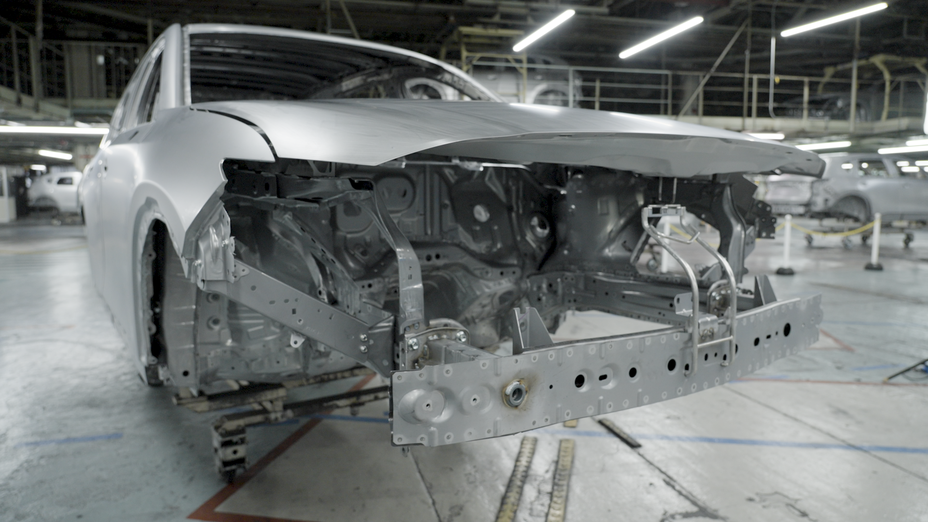
The new bumper reinforcement in the all-new CX-5. A bumper reinforcement is a structural beam that runs across the front of the car to absorb impact in a collision. On the all-new CX-5, it has been extended on both sides. Even in accidents where only a corner of the car is hit, it is designed to transfer the impact to the car's strong frame so it can be absorbed. It is also the world's first adoption of a high-bending 2.0 GPa-class hot-stamped steel sheet developed by Nippon Steel, which keeps the reinforcement high-strength while reducing weight.
Helping to Protect the Life of a Loved One
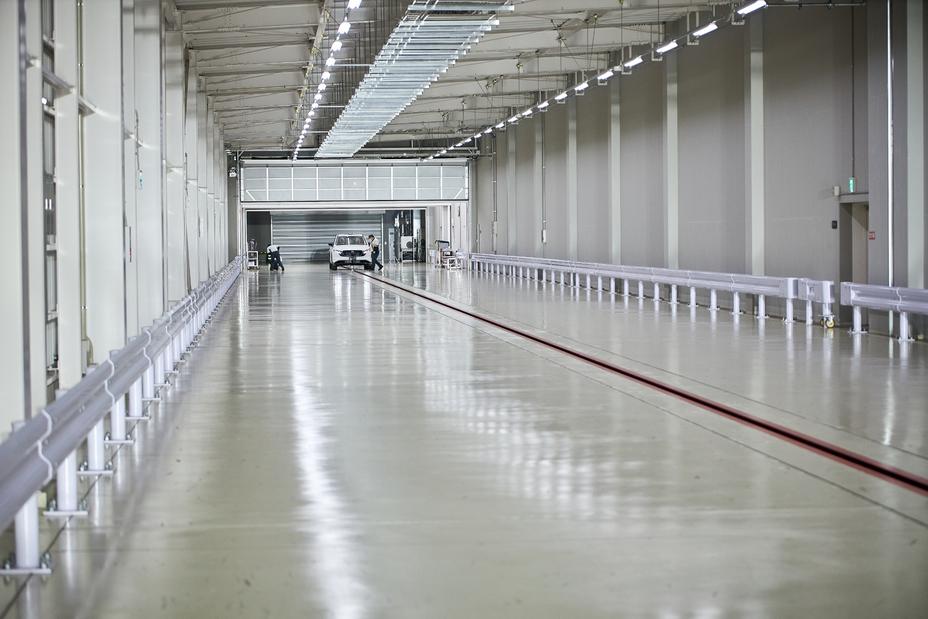
5, 4, 3... The countdown begins. There is only one chance.
The tension rises.
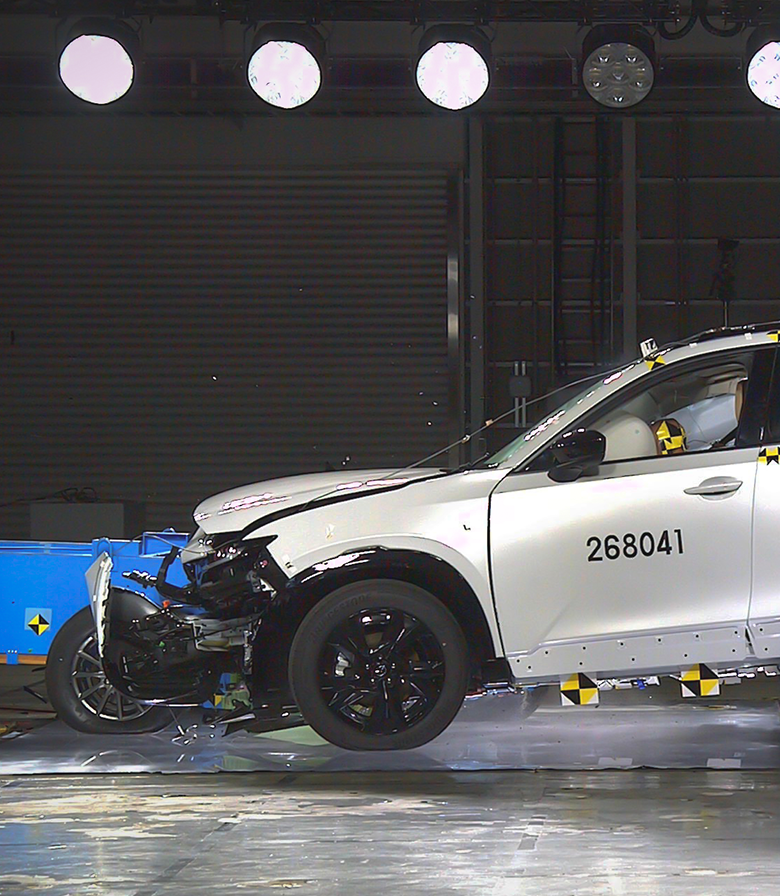
Impact. With a roar, the front of the car crumples. Both vehicles are traveling at 50 km/h, for a combined impact speed of 100 km/h.
Yet the cabin held its shape and stayed intact. Even after such a heavy impact, the doors opened without any problem.
A cabin that absorbed the impact while helping to protect the occupants, and doors that still opened afterward. These were the same qualities that helped protect Michael and allowed him to get out of the car on his own. These were what saved his life.

For Michael, Mazda's long-standing commitment to aiming for zero fatal accidents in Real World conditions made a real difference. Hamada says that behind this development philosophy, he sees the lives of Mazda's customers.
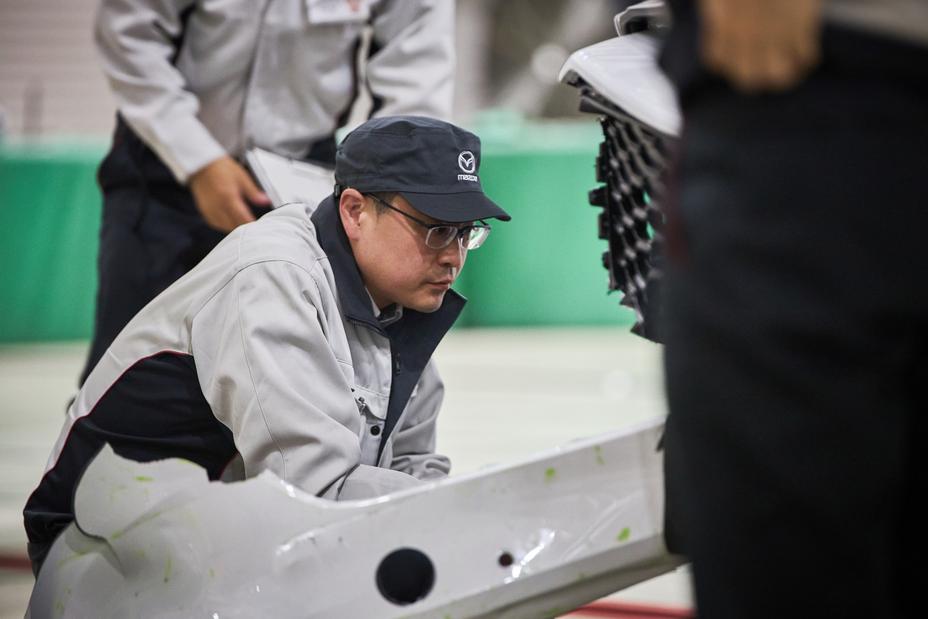
Hamada:
An accident can affect the rest of a person's life, leaving lasting injuries or disabilities. Losing a loved one can be even more devastating.
I believe working on safety means being entrusted with part of our customers' lives. The work is demanding and has many constraints, but we can't compromise. I do my job while picturing the people and the lives behind every vehicle.
After the accident, Michael bought the same red CX-30. Living in an area where a car is essential and driving for work meant that for Michael, getting back behind the wheel after the accident was also a way of getting his everyday life back. Today, he still drives that CX-30 between his home in Philadelphia and his parents' house, and to visit friends.
After the accident, his mother Laura bought a Mazda CX-50. His father Greg chose a CX-50 too, as his companion for work that has him driving about 40,000 km a year. Michael coming home safely changed how the whole family chose their cars.
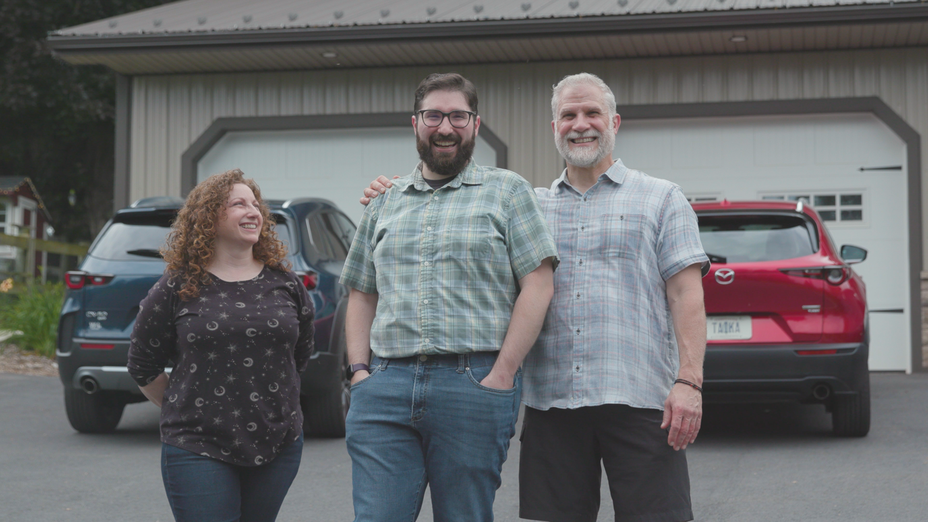
Laura:
It's a huge comfort to know that if I can't be there, at least I know that he's safe in his car. So that's a good feeling.
Greg:
Being a Mazda family is really important to me because family is everything. Most importantly, I can have some peace at night knowing that my family are driving one of the safest vehicles on the road. And that gives me a lot of comfort as a father and a husband.
At the end of the interview, Michael shared a message for Mazda's engineers.
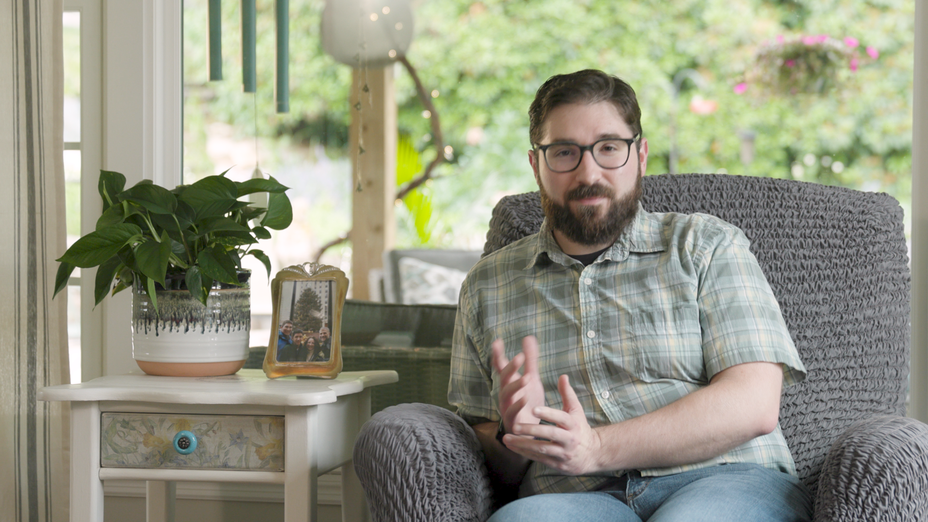
Michael:
First and foremost, thank you. I don't think I would be here if it wasn't for your ingenuity, your painstaking, meticulous care of what goes into making a car and the safety features of it all. I don't have words to express how thankful I am, but at the very least, thank you.
Mazda's engineers look beyond regulations and assessment tests to every real-world accident. That work helped protect one life and a family's future.
Mazda aims to create a mobility society where everyone can enjoy the freedom of movement and the joy of driving, free from fear of accidents. To bring that vision closer to reality, Mazda's engineers continue to push the boundaries of safety every day.
From the Editorial Team
Cars enrich our lives. But what if there is an accident? What if someone we love is hurt? Listening to the Polk family's story, I found myself thinking about my own family. But what reassured me was that the same care I feel for my family, Mazda's engineers bring to their work every day, thinking about the lives of the people in these cars.
No one wants to find out firsthand how well a car protects them. But simply knowing there are engineers who care this much about drivers and their families brings real peace of mind to everyday life on the road. That is the feeling the story left me with.
Related Contents
SAFETY - MAXIMIZE YOUR POTENTIAL
To realize cars and a society that offer safety and peace of mind